Confidence
Includes an athletes confidence in their abilities, training and preparation, leading to their confidence in replicating those abilities in a match situation. Confidence can be improved with experience in the sport, modelling (observation, imagery and self-talk) and feedback from coaches or other surrounding support (5).
Experience (1)
- hard work
- dedication
- consistent preparation
- specific match tactics/plays
Imagery (1)
- Used to cue what to expect in a match situation and the subsequent response
- Imagining a situation and relevant sensations
- Can use prompts or self talk to facilitate
- Can show athletes videos of match situations
Self Talk (1)
- Boosts athlete confidence through affirmations
- Directs attention to the present moment
- Motivational (e.g. “you can do it”)
- Calming (e.g. “relax”, “loose grip”)
- Skill or cue-specific (e.g. “quick hands”, “follow through”)
Anxiety Management
Can involve a goal keeper dealing with the pressure that is placed on them and the consequences of their mistakes. All hockey players will deal with this as well, dealing with stress and set backs, fear of failure or injury or letting their team down. stressful nature of elite sport, stress management usually a component of comp prep to achieve optimal per performance mental and physical state (4).
For optimal performance, an athletes arousal will lie somewhere on a continuum, from sleep to high excitation in physiological, cognitive and behavioural capacities (7). The Inverted U hypothesis states that moderate arousal will result in optimal performance, and that anything above or below this will negatively affect performance (7). Therefore, athletes must be equipped with the individual tools to achieve their optimal arousal. It is also important to note that the peak of the inverted U may lie at different areas of the continuum depending on the sport (7). For example, field hockey requires higher arousal than golf would.
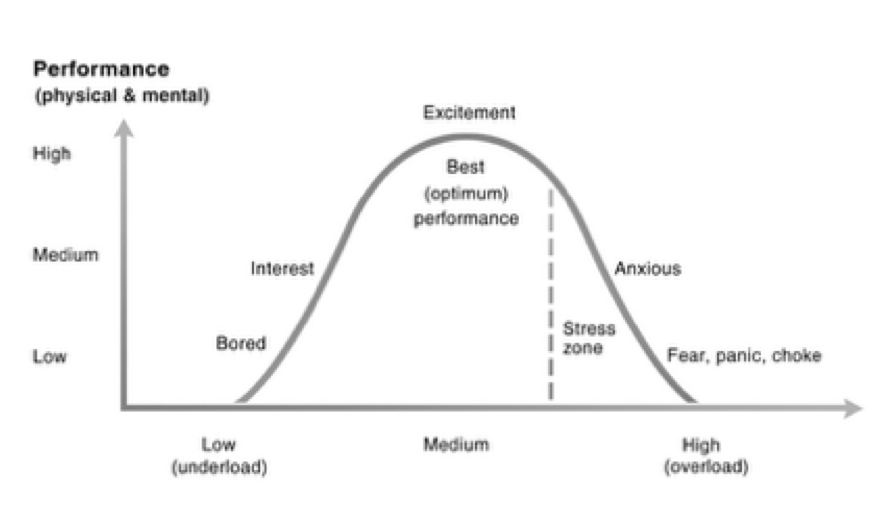
Strategies for optimal arousal may include, but are not limited to (1):
- Pre-performance routine
- Breathing exercises
- Stretching
- Listening to music
- Meditation
- Activation/energising
 High Performance Field Hockey